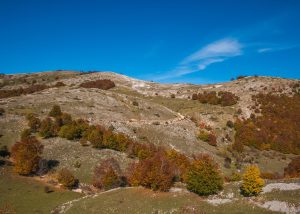
If you are looking for an authentic place off the beaten track, Castrovalva is a must-see on your itinerary in Abruzzo. A tiny mountain village, perched over 800 meters above sea level, it welcomes visitors with spectacular views and an atmosphere that seems suspended in time.
In this article we tell you what to see in Castrovalva, but more importantly why it is worth experiencing it slowly, among quiet alleys and breathtaking views.
A village suspended in time
In Castrovalva you will not find large squares or famous monuments, but the authentic essence of a village that lives out of time. Its inhabitants - just about fifteen of them - are an integral part of the experience: just sit at the small village bar or stop along a street to chat and immediately feel welcomed as one of home.
The village is also known as the "crazy town." Here, in fact, everything flows according to its own rules: patronal festivals do not follow the official calendar, processions are moved to ensure everyone's participation, and traditions are kept at a personal pace, far from external conventions and impositions.
This freedom in community living is what makes Castrovalva so fascinating. The nickname, far from being negative, becomes a symbol of independence, authenticity and cohesion: the sign of a village that has chosen to remain true to itself, celebrating life according to its own rules.
What to see in Castrovalva
Despite its small size, Castrovalva holds some interesting churches that testify to its centuries-old history.
St. Michael's Church
Just outside the town is the small church dedicated to the village's patron saint, built over an ancient place of worship dating from the 12th century. Its medieval origins are still perceptible in the crypt, while the present structure, remodeled in the 16th-17th centuries and then in the 19th century, has retained a simple hall plan with round arches.
Inside, the high altar houses a 20th-century statue of St. Michael, while the 18th-century original is kept in the parish of Our Lady of Grace.
Church of Santa Maria delle Grazie
It is the parish of the village and stands over an ancient chapel of St. Thomas mentioned as early as 1188 by Pope Clement III. Its Renaissance facade is simple but enriched by a Romanesque-style portal with fine decorations: little angels holding the Belprato coat of arms, plant motifs, and a blessing Christ frescoed in the lunette.

Inside, with a single hall, are impressive statues and works of art, such as the polychrome sculpture of St. Lucy, which seems to follow the viewer with its gaze, and the 16th-century Madonna and Child.
The high altar is embellished with 18th-century paintings and a 17th-century gilded wooden tabernacle with a moving Deposition of Christ.
Church of Santa Maria ad Nives
It overlooks the main square and dates back to the Middle Ages, although it was rebuilt in the 16th century. The facade, enlivened by the Baroque crowning, has a portal in the center surmounted by a fresco of the Madonna and Child.

The three-nave 18th-century interior is enriched by pillars decorated in faux marble, cross vaults, and a hemispherical dome that dominates the presbytery. Among the works housed is an 18th-century painting of the Apparition of Our Lady of the Incoronata, linked to the tradition of transhumance, and an 18th-century statue of St. Michael the Archangel, a symbol of protection and justice.
Castrovalva and the art of Escher
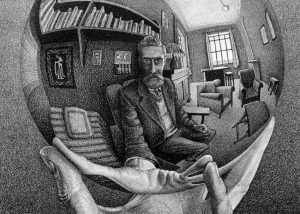
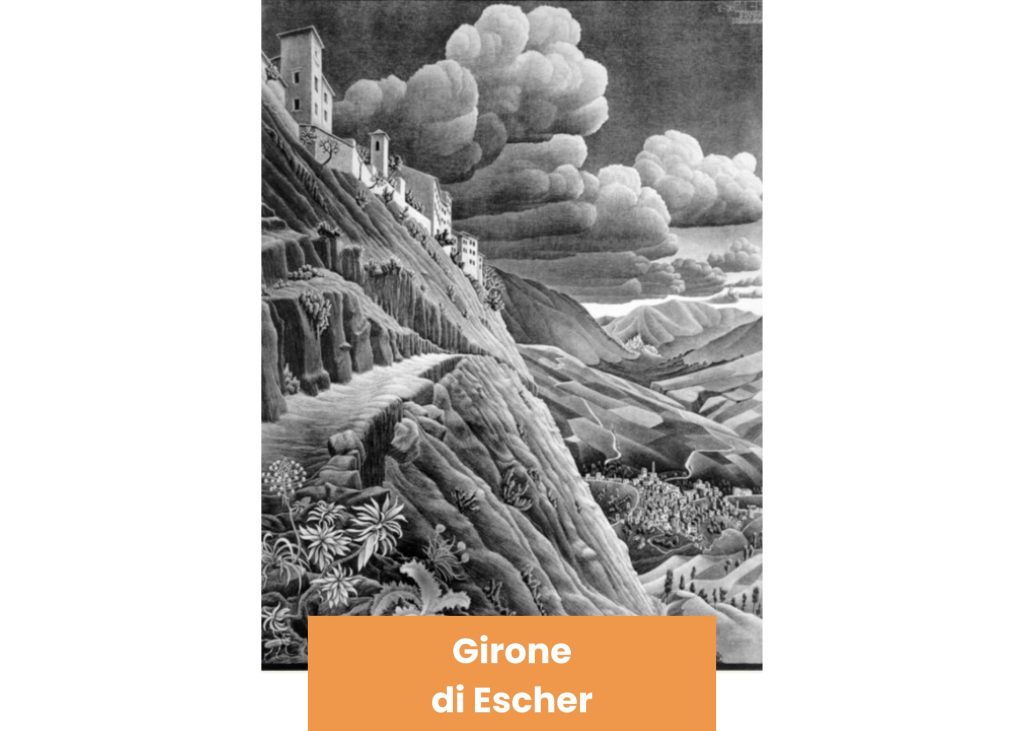
The connection between Castrovalva and Dutch artist Maurits Cornelis Escher is now an integral part of the village's identity.
It was here, in fact, that the artist found inspiration in the 1930s, enchanted by the village's perched profile and dizzying perspectives that made him the subject of one of his famous lithographs.
It is no coincidence that the last hairpin bend before the entrance to the village bears his name, a tribute to the master whose art contributed to making this corner of Abruzzo known beyond national borders (for more on this, read our dedicated article).
Visiting tips
Castrovalva is located at 820 meters above sea level, reached via a winding and scenic road that climbs from the Sagittario Gorge Nature Reserve. The route itself is already part of the experience, with tight curves overlooking spectacular overhangs.
The village has just 14 inhabitants, making it an out-of-the-ordinary place: quiet, cozy and far from any form of mass tourism. This is precisely why it is ideal to include as a stop on a larger itinerary, perhaps combining a visit to Anversa degli Abruzzi, the Sagittario Gorge Reserve or the nearby villages of Villalago and Scanno.
Conclusion
To visit Castrovalva is to have an experience that interweaves nature, history and artistic suggestions.
It is a place that invites you to slow down, to savor the simple and true beauty, and that leaves an indelible memory in the hearts of those who arrive.